
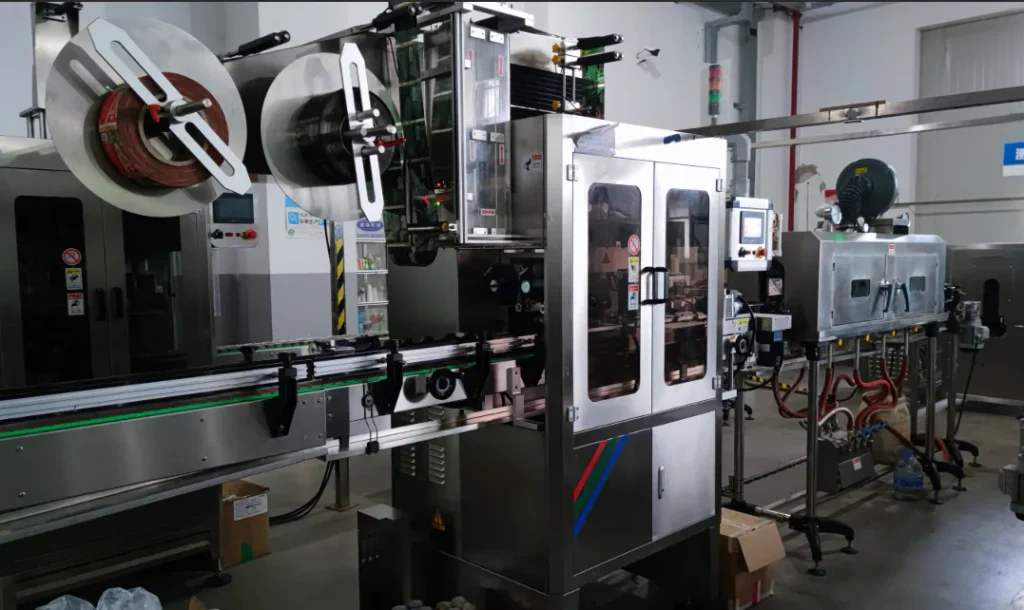
The price of a shrink sleeve labeling machine is only part of the total cost. A lower-priced machine may cost more to run if it wastes labels, stops often or needs extra equipment.
A sleeve applicator cuts the sleeve and places it on the container. A shrink tunnel then uses heat to shrink the label around it. Both machines must work well with your product and the rest of the line.
Before you compare quotations, check these nine areas. They can affect your daily output, running costs and time spent on maintenance.
1. Check the Real Production Speed
The speed shown in a brochure is not always the speed you can use in daily production. A machine rated at 300 bottles per minute may run at a lower speed with your bottle and sleeve.
Bottle shape, height, weight and base design all matter. A tall, light bottle with a narrow base may be harder to handle than a filled round bottle with a wide base. Long sleeves and thin films can also affect the speed.
The rest of the line matters too. The applicator will stop if bottles do not arrive steadily or if finished bottles build up after the tunnel.
Ask the supplier to confirm the stable speed for each main bottle and sleeve size. Use tests with your real products, and agree on the conditions for that speed.
2. Check How Much Sleeve Material Is Wasted
Sleeve labels are a daily cost. A small amount of repeated waste can add up over a year.
Waste may come from uneven film feeding, poor cutting, sleeves that do not open fully or labels placed at the wrong height. Film joints can also cause defects if the line does not detect and handle them correctly.
For printed sleeves, the machine may use a registration mark, also called an eye mark. This is a small printed mark that the sensor reads to help control the cut position. Poor detection can lead to cuts through the artwork.
A servo motor can help control movement, but the feed wheels, cutter and sleeve-opening parts must also work well together. The machine settings and label quality matter too.
During a test, count the wasted sleeves and note the causes. Check what happens when the machine starts, stops and changes speed.
Annual sleeve waste cost = wasted sleeves per day × cost per sleeve × operating days per year
This estimate covers the wasted labels only. Stops, extra labor and rework can add more cost.
3. Choose the Right Shrink Tunnel
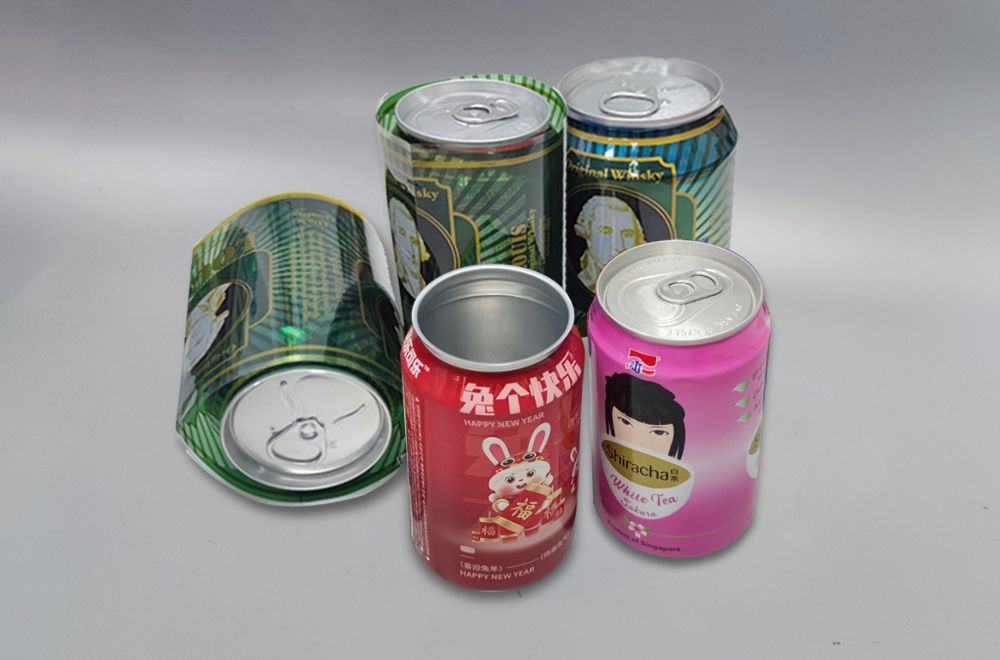
A correctly applied sleeve still needs the right shrink tunnel. Poor shrinking can leave wrinkles, distort the artwork or damage the container.
The choice depends on the film, container material, product shape and line speed. Whether the container is empty or filled also matters. Different films may need different heat settings.
Steam tunnels provide even heat and are often a good choice for full-body sleeves on shaped containers. Electric hot-air tunnels use dry heat. They can suit some applications where moisture is a concern or a steam supply is not available.
Some products need several heating zones or more than one shrink stage. Test the actual container and printed sleeve before you confirm the tunnel.
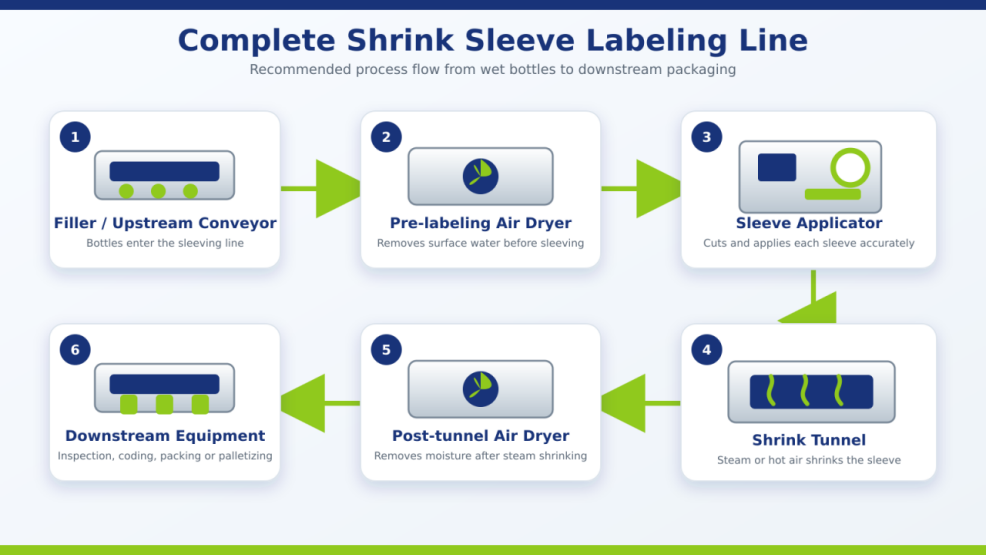
Include the costs of steam or electricity, water treatment, drainage and ventilation where needed. Wet bottles may need an air dryer before the applicator. Bottles leaving a steam tunnel may need another dryer.
Check the finished label at the shoulder, body and bottom edge. Also check the print and barcode for unwanted distortion.
4. Measure the Time Needed to Change Products
A fast machine loses production time while operators change it to the next product. This matters when your line runs several bottle sizes or label designs.
A product change, often called a changeover, may involve replacing the mandrel or timing screw. The mandrel opens the sleeve. The timing screw separates the bottles and controls their spacing.
Operators may also need to adjust the guide rails, holding belts, sensors, machine height and tunnel settings. They must load the new sleeve roll and check the first finished bottles.
Clear scales, handwheels and saved settings can make this work easier. A saved recipe on the touch screen helps recall settings, but it does not replace physical adjustments or change parts.
Ask for a complete changeover demonstration. Confirm which parts are included, which parts each bottle needs and how much future change parts will cost.
5. Check Component Models as Well as Brands
Two machines can use the same electrical brands and still perform differently. Each brand offers different models, power ratings and control functions.
Check the main components that affect production and maintenance. These may include the PLC, servo motors and drives, variable frequency drives and sensors. The PLC runs the machine program. A variable frequency drive, or VFD, controls a motor’s speed.
Confirm the machine’s incoming voltage and frequency. Also check the local electrical requirements and the ratings of parts you may need to replace. Matching the power supply alone does not prove that a machine meets all local requirements.
Request the brands and models of the main electrical parts. Use this list to compare the proposals and plan future maintenance.
6. Look at the Mechanical Design and Control Program
A quotation cannot show every detail of a machine. Part accuracy, assembly and the control program can make a large difference during daily production.
The feed wheels must guide the film evenly. The cutter must work with the feed system. The bottle guides and holding belts must let bottles move smoothly through the machine.
The control program must keep these movements in step. It must also handle missing bottles, bottle build-up, label faults and signals from other machines.
A heavy frame alone does not prove that a machine will run steadily. Watch it at low speed and at the agreed production speed. Look for vibration, unusual noise, label movement and unstable bottle transfer.
Ask the supplier to show how the machine stops for a bottle shortage or a blocked outlet. Check how it restarts after the problem is cleared.
7. Compare What Each Quotation Includes
A lower total price may cover less equipment. Compare the items in each quotation before you compare the final amount.
Depending on the project, a complete system may include the following items.
- Sleeve applicator and shrink tunnel
- Conveyors and air dryers
- Steam generator, if a suitable steam supply is not available
- Sleeve buffer, printer and label inspection or rejection system
- Change parts, spare parts, installation and operator training
Confirm how the new system connects to your existing line. Agree on conveyor height, direction, chain or belt type, power connections and control signals. Clarify any safety connections between machines.
Ask each supplier to state what is included, what is optional and what you must provide. Confirm who supplies the connecting conveyors and who is responsible for work at the installation site.
8. Agree on Technical Support Before You Buy
When a line stops, waiting for help can be expensive. Check the support plan before you place an order.
Ask how the supplier will find the cause of mechanical, electrical and software faults. Confirm how remote support works and what happens if a problem needs an on-site visit.
You should also receive clear operating instructions, electrical drawings and alarm information. Ask which spare and wear parts you should keep, and how long replacement parts usually take to arrive.
The supplier should understand the machine’s control program. Good support also depends on useful documents, experienced engineers and available spare parts.
Agree on warranty coverage, excluded wear parts, training, service hours and any travel or service charges. Ask whether new change parts will be available when you add a bottle size later.
9. Test Your Bottles and Labels Before Final Approval
A machine running without bottles or labels is only a dry run. It shows that the parts move, but it does not prove the final labeling or shrinking result.
Use your actual bottles and printed sleeves for the factory acceptance test, or FAT. Agree on the test speed, duration, product sizes and quality checks before the test.
Check the cut, label position, bottle stability, waste and finished shrink result. Watch normal starts and stops too. If your bottles differ greatly in size or shape, test the main formats separately.
A short test cannot prove several hours of continuous production. State what the factory test will confirm and what you will check after installation at your site.
At Procus, we recommend testing physical bottle and sleeve samples for difficult or non-standard applications before confirming the final design.
Compare the Total Cost
The total cost includes the purchase price and the cost of running the system. Use this table to compare the main points.
| Cost area | Possible extra cost | What to check |
| Purchase | Missing equipment or change parts | Included items and quantities |
| Production speed | Lower daily output | Tested speed with your products |
| Sleeve waste | Wasted labels and rework | Waste during the agreed test |
| Shrinking | Rejected products and utility use | Finished samples and utility needs |
| Product changes | Time lost between products | Complete changeover demonstration |
| Line connections | Extra work during installation | Layout and supply responsibilities |
| Maintenance | Wear parts and delivery delays | Parts list, prices and availability |
| Soutien | Long stops while waiting for help | Service process and charges |
A Checklist Before You Order
Confirm these points with the supplier and record them in the proposal or order details.
- Bottle dimensions, material and whether it is empty or filled
- Bottle condition when it enters the line, including wet or dry
- Sleeve material, thickness, layflat width and cut length
- Registration mark requirements and the required label position
- Stable production speed for each main bottle and sleeve size
- Shrink tunnel type, heating zones and utility needs
- Complete equipment list and connections to the existing line
- Included change parts and the changeover procedure
- Main electrical component models and local power requirements
- Factory test method, quality checks and checks after installation
- Warranty, training, technical support and spare parts
Layflat width is the width of the sleeve tube when it is pressed flat. Cut length is the length of each sleeve cut from the roll.
Choose a System That Fits Your Production
The lowest quotation may be the best choice, but only if it covers your needs. Compare tested performance, running costs and support as well as the purchase price.
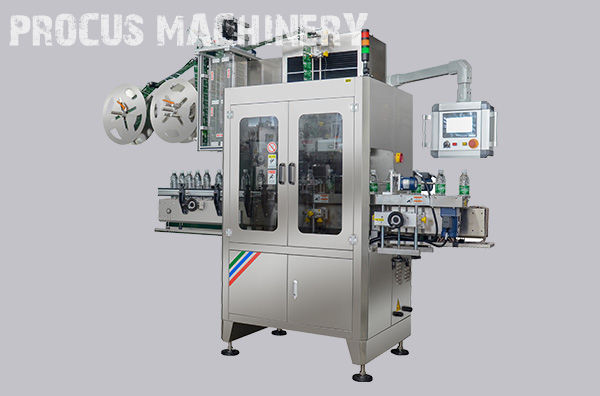
At Procus Machinery, we review your bottle, sleeve, label position, required speed and line layout before recommending a system. Our manufacturing factory, Shanghai Shousong, has focused on shrink sleeve labeling machinery since 2007.
To discuss your project, send us bottle photos and dimensions, sleeve details, required speed and whether the containers are empty or filled. Please also share your local power supply, available steam supply and line layout. We can then recommend a suitable sleeve applicator, shrink tunnel and supporting equipment.


 : No. 158, Shiwei Road, Nanfeng Highway, Qingcun Town, Fengxian District, Shanghai, Chine.
 : 0086-2161646783
 : marketing@procusmachinery.com
 :
:  : www.procusmachinery.com